Showing posts with label bees. Show all posts

September 4, 2014

Funny Bee Story

It's been a few years since we've had honey bees at our place.  We've tried three times.  Two were bought from the store and the third swarm adopted us.  But I think that we don't have a warm enough place for them because every winter they die.

That's not the funny part.

The first time we tried honey bees on our property, we let our neighbors know.  Not all the neighbors, as required by state law, just the neighbors we know and talk to every once in a while.  Bees travel up to a mile for their pollen, so I suppose we should have talked to a lot more people.  But I figure they wouldn't know my bees from any others out there.  It's not like they have an ID bracelet that says "If found return to Brooks' Hobby Farm."

One Saturday morning, shortly after the first hive of bees arrived, the phone rings.  I answer and the lady says, "Hi.  I'm your neighbor on the north side." (Not a neighbor I usually talk with and therefore didn't know about the bees.)  She continues, "Lola said you guys got honey bees and I think they may be moving into our attic."  (Lola is our wonderful neighbor and probably mentioned it in passing.)  I replied, "Yes, we got honey bees.  Why do you think they are moving into your attic?"

I should note that in my professional career I deal with angry and frustrated people on a daily basis.  After 15 years of trial and error (a lot of trial and error), I have learned how to respond to any unknown entity without 1) being defensive; or 2) revealing anything but simple facts.  I think those are really important tack-ticks when working with neighbors regarding bees, pets, fences, trees, noise or anything else, ever.

Anyway, she asked "Do you have all your bees?"  That caused me a pause.  A hive of honey bees is like 30,000 bees.  Do have them all?  Well, let me go count them and see.  All I could say was, "I think so."

She proceeded to tell me that she was seeing one or two bees fly into and out of the attic frequently for the past few days.  She was concerned that the bees were slowly moving into her attic.  Again she asked if I was sure I had all my bees.  I replied that I would go check.  However, I told her, bees don't move homes like that.  If a hive gets too large for its home, an entire swarm of about 10,000 bees leaves the hive.  The swarm moves, all together, while drones go look for a new home.  When a drone finds a new home, the entire swarm moves in all at once.

We purchase only about 10,000 bees to start the hive. We only had them for a few days at that point, so it was highly unlikely that a swarm had left.  But since she was clearly frustrated and thinking the invasion was my fault, I said I would go check the hive and call her back.

About 10,000 bees - ready to move into the hive
I'm not sure what she thought I would do.  But what I did do was go down and listen to see if there was a lot of buzzing coming from the hive.  There was and a few bees were coming and going to gather food.  Did we have them all?  I don't know.  But odds were that we did. I call the lady back and said yes, we have all our bees.  Thankfully, she accepted that answer.  She didn't have too, but she did.  Her tone because a bit desperate.  She wanted to know what she should do.

I get it.  Most people have a healthy fear of bees.  The sound of buzzing is used in horror movies because it makes humans react and get agitated.  But the truth is that bees (not wasps) are not aggressive.  Honey bees are docile unless threatened.  Yes, swatting your hand at a bee is aggressive and it may react.  Seriously, if someone started smacking you for no apparent reason while you were walking down the sidewalk minding your own business, you would probably react too.  And truth be told, if a swarm of honey bees takes up residence in your attic, they will do a massive amount of damage!

I gave the woman a few numbers to call.  I let her know that she should work with some professionals to get the swarm out of the attic and moved into a proper home.  Perhaps I scared her a little, telling her about how much damage the weight of their honey could cause.  But she was happy to have some people to call for help.

Ok, maybe that story isn't actually funny.  I just can't get over "Do you have all your bees?"

May 10, 2011

A Little Success

I'm holed-up with the flu. I came down with it yesterday at work. The day started OK, but my throat was scratchy and annoying. I should have known something was wrong, but I ignored it and kept working. On the walk from my office to car to go home the fever hit, followed by shakes that made driving in rush-hour traffic a bit nerve wracking. By the time I got Jordan from after-school-care the aches had set in. Once we got home, I changed into my most comfortable jammies and I laid on the couch all evening letting Jeremy and Jordan take care of me.

This morning I was better, but not by much. So I called in sick to work, slowly gathered a blanket, tea and the book I'm reading and settled back into the couch. I napped most of the day. Then around 3:30pm there was a knock on the door. My parents had come over to check on the bees. Last Sunday, on Mother's Day, they had said they were going to come to check on the bees, but my flu-stupor made me forget. They, in turn, were not expecting me to be home and were surprised to see my Pacifica in the driveway. After learning I was sick, Mom decided not to come into the house - smart, the air was probably thick with flu bugs. Dad ventured in but only long enough to make some sugar water and I think he held is breath. Since the sun had come out, I decided I could use some fresh air and headed down to the hive with them.

The first step to checking on the bees, is to get all the equipment out and ready. It took some serious effort to get the smoker started because the newspaper and kindling that we keep in the barn were damp-ish due to the persistent, misty rain that only cleared today. I sat on the old railroad beams, covered in moss because my legs felt weak and was of no help at all. Finally the fire took and we walked over to the hive.

Dad pumped a little smoke in through the entrance and then propped up one edge of the top and pumped in a bit more. Then he removed the top and took out the frame feeder. We have been keeping the frame feeder full of sugar water since bringing the bees home. In a normal year, we probably could have stopped supplementing their food by now, but it has been so cold and rainy that all the flowers, and our orchard, are at least one month behind. We have also put a pollen cake in the hive every other week. There was no sign of the last pollen cake and the frame feeder was nearly empty. As Dad filled it I peaked in between the frames. The bees had drawn out comb on all by the most-outer-edge frames.

For those who are not bee keepers -- The frames are a sheet of grooved plastic in a wooden frame. The bees build comb off the plastic; this is called "drawing out" comb. In the middle most drawn out frames, the queen starts to lay eggs. In the outer most drawn out frames, the bees make honey. We decided to pull one of the frames to see how it looks. Honey! They are already making honey! I can almost taste it!

Since all looked great we put the frame and full frame feeder back in. Mom laid a new pollen cake on the top of the frames and we shut up the hive.

So if not for the flu, I would have been at work and missed the hive opening.

April 7, 2011

A Bee Story

This might take a little while to tell, so I'll give away the ending right now... We got new honey bees and successfully moved them in to their home! Ok, now the long version -

Last year, in April, we got a box-o-bees. It was a cold, rainy day when we put them in the hive and it didn't get warm for many days after that. Not knowing much about raising bees in the Pacific Northwest, we had purchased a top feeder. It's a tray that fits over the top of the hive; you fill it with sugar water. But it was so cold that the bees never came up the top to feed. They all died.

We purchased a second round of bees. This time we went with a nuc. A nuc is a small, 5 frame, hive that you put simply into the big hive. It was much easier. Also, it was one month later and warm. The bees did great all summer long. They brought the comb out, filled cells with honey and raised lots of little bees. Then in the fall, the weather got cold and rainy. One day we came down to check on the bees and they were all dead. They hadn't left the hive. There was no sign of disease, mites, fungus - nothing. Just thousands of dead bees. It sucked! Sad and discouraged we put the hive and equipment went in the barn for the winter.

So here we are one April later and ready to make another attempt at raising honey bees. The first decision was to change hive's location. Jeremy and my Dad chose a spot near the barn and across the creek that gets direct sun from about noon until 3pm, the rest of the time there is dappled shade. The second decision was to use the frame feeder. Basically, it's a hollow, narrow plastic rectangle that sits down in the hive. The bees therefore don't have to come up the the top to eat. Third, my Dad decided to use a solid base, instead of a screen base, for the hive. This would mean the bees could work less hard to warm the hive.

The bees were set to arrive a week ago - the first weekend of April. However, the unseasonably cold weather in northern California made it impossible for the bees to be brought up. Then this week has been Jordan's spring break and she and headed to the cabin. Ruhl (the honey bee supply store) called to say that the bees would arrive on Thursday and must be picked up by Friday afternoon. Meaning me and my Mom would have to take care of the bees alone.

I got a little panic-y. It's not that I'm that afraid of bees - although being afraid of bees is the most common fear besides public speaking and spiders. But the process of putting them in the hive last year was a little nerve wracking. Bottom line, you have to shake the bees from the box into the hive. And I'm talking about 10,000 bees. Shaking the crap out of thousands of bees it's my idea of a good time. So, I started making inquiries about getting some help. I contacted the Clark County Beekeepers Association and Urban Growth Bounty, from whom we took a class about honey bees. My request was - Could someone please come help me! Desperate I know, but I was desperate. I got speedy and multiple responses. The association sent me some videos and advice. The links to the videos are below. The advice was to calm down. Literally. Everyone who got back to me said that this was simple and I could do it. I did get a few potential takers to come help. But my pride kicked in and I decided that me and my Mom could totally handle this!

Mom and I made the drive to Ruhl in Gladstone, OR on Friday. It was a glorious morning - sunny and warm (well, warm for April in the Pacific Northwest). We picked up our bees. Truly amazing that ten thousand bees can fit in a 18" by 10" by 4" box. After arriving home and having some lunch, we headed down the hive and got to work!

First we got everything out and put on the regalia. Some sexy outfits for sure! Then we read, re-read and re-read the instructions Ruhl sent with the box. In watching the videos, we learned that shaking the bees out is not necessary. Whew! So ... 1) remove five frames. 2) fill the feeder and put in the place of one of the frames. 3) remove the can of sugar water from the box-o-bees and quickly pull the queen out and put the can back in. 4) secure the queen to a frame, using a rubber band (genius). 5) put the queen/frame back in the hive. 6) remove the can of sugar water and put the whole box in the hive. 7) close it all up. No problem! We didn't even get stung.

All done now. The bees were out flying today, making big circles checking out the territory. Crossed fingers that they will survive and make it through the summer, fall and winter. Next spring, with any luck, the hive will be thriving and
we'll have some extra honey to partake in.

The videos about getting bees installed and feeding them:

February 19, 2011

Fruit Tree Pruning


I know we have a little bit longer until the official first day of spring, but today was for all intents and purposes the my first day. It was very cold this morning due to a perfectly clear sky. By 11am however, it had warmed up and the sunlight was peaking through the trees. We headed outside.

The tulips, daffodils, iris and lilies had sent up an inch to 4 inches of green leaves. Leaf buds were starting on all the shrubs. The birds were going crazy after days of cold and rain. It was glorious.

I decided to ease into pruning by tiding up the flowerbeds. We have very large flowerbeds all around our house. They had all been neglected since last fall, so there was dead plant stuff everywhere. I pulled this all out, loading it into the wheelbarrow. From there, Jeremy took loads to the fire out back. Jeremy also made a good dent in the blackberries, putting them on the fire too. The damp leaves and reeds smoked something awful. I'm sure our neighbors really appreciated being drenched in thick smoke all day. Thankfully, the rest of the county was burning too.

Next were the roses. President's Day is typically my rose pruning day and I figured two days early wouldn't hurt anything. We have roses in all the flower beds and all along the driveway to the road. It's amazing how regular garden gloves won't stop a rose thorn. I have cuts and scrapes all over my hands. But with any luck we'll have lovely roses this summer to greet us when we get home every day.

On to pruning the fruit trees. Last year I found a great little book called "Dwarf Fruit Trees for the Home Gardener" (by Lawrence Southwick), copyright 1972. All my fruit trees are dwarf to facilitate easier fruit picking. In reading the book I learned something very important - you don't prune all fruit trees the same way. You're probably thinking, well duh! But I honestly thought the point was just to remove dead or dying branches. Turns out that this is generally true, but there are some other "rules" for each trees.

First, apple and pear tree branches need to support a lot of weight. It's important to remove weird angle branches, weak ones and those that are competing (running into each other). You can train these trees by trimming to keep them short or tying to fences and trellises to spread the branches out. We have 22 apple and pear trees ranging in age from one to five years, and one old apple tree out in the pasture. I prune them every year, so it's not a big chore just simple maintenance.

Peach trees are different. Peaches grow on new-growth branches, not old ones. So thinning the peach tree each year to remove old branches and dead material helps you get more fruit. This takes a lot more time, walking around the tree, taking a branch here and a branch there. Fortunately we only have one peach tree, so it didn't take too long. Last year we got 7 peaches on this 5 year old tree. I hope for many, many more this year.

We also have plum trees, which don't require much pruning until they get older. I just removed dead branches and trimmed the really tall ones (I don't like having to climb on ladder to pick fruit - I'm lazy that way). The other fruit tree we have is a persimmons - it's not covered in the dwarf book. I skipped it for now and will do more research about this neat tree.

The very last thing I did today was to move the mason bees. We have one block full of tubes with bees that are quickly maturing and getting ready to come out and pollinate the now pruned fruit trees. I put the whole block into a box and taped it shut except for a small hole where the bees can escape. I put the box under a new block full of new tubes. Over the next month the bees should hatch and take up residence in the new block. Their hard work should produce lovely apples, pears, peaches and plums for us to enjoy. Thank you little bees!

August 29, 2010

Nesting Bees

Saturday morning my cell phone rang. That is strange because we don't get cell reception at our house, unless you lean far off the back deck, stretching the phone towards the southern sky. When it rang, I didn't even make an effort to answer. But the voice mail alert went off, so I headed to the deck to retrieve the message.

It was my neighbor - not Eric or Lola, the neighbors to the north who we have only met when our cow, Gladys, got out and proceeded to eat their garden. Sherry's message went something like this "Your other neighbors told us you got bees and I was wondering if they are still in their nest because we have bees coming and going from our attic. Please give me a call back [phone number]." I thought, crap, did the hive swarm?!

I ran down in my pajamas and flip flops. It was a cool morning, so no bees were flying. I carefully (because I hadn't put on any protective wear) opened the top lid. I was met with a nice, soft buzzing and lots of bees happily going about their business. Whew - no swarm!!! I put the lid back down and headed up to call Sherry back (on my land line so I didn't have to hang off the deck).

Sherry said "About two weeks after you got your bees, I noticed little honey bees going in and out off the attic." (Mind you, we got our bees in May, so that means she's had bees in her attic for 3 months.) "So I thought maybe your bees were moving their nest." In the nicest way possible I said "They don't really do it that way. See, when part of the hive decides to move, they swarm out. We're talking 10,000 bees in one large bunch. They generally move to a tree and hang out there while scouts go find a new home. Then them all move in." Sherry said "Oh, cuz this started just after you got your bees." (Like it's my fault that honey bees look up residence in her attic.) "Could you come get them?"

"Well, I would but I don't have anything to put them in. If I had a second hive, I would love to get the bees. But I don't. You should call Rhul (the store that we bought our bees from) and ask them if there are bee keepers in Southwest Washington that would come get the bees. I'm sure there are many that would be thrilled to come help you out." What I should have done, but didn't think of it, was to direct her to the Clark County Bee Keepers Association. I bet they could have sent someone out in 10 minutes.

I haven't heard back from her, so I assume she got the situation taken care of. Our bees are doing great. We added a second super, which they have drawn out. We are thinking of adding a third shallow super to the top and see if we can get any honey for us this fall. Yum!!

May 15, 2010

Bees are Flying


We have three bird houses on the deck. Last year each had birds - black capped chickadees and swallows. This year two of the houses are occupied with birds, but the one on the end isn't. Bumble bees have taken up residence there.

Bumble bees create nests in abandoned homes of rodents or birds, anything with good nesting materials. The queen goes in and lays a bunch of eggs. She makes them all girls. (It just amazes me that bees choose the sex of their offspring.) As soon as they hatch their only job is to go gather food. The queen keeps laying eggs. This goes on for a month or so, depending on the variety - there are about 45 varieties of bumble bees in our area. Then the bees make a new queen and she goes to hibernate somewhere - all the rest die. They don't come back to that nest; the new queen will pick a new place next spring.

Where did all this bee knowledge come from you ask? I spent Friday at a Pollinator Workshop put on by the Xerces Society and sponsored by the Oregon Zoo. It was one of the best workshops I've attended and it included a tour of four bee spots at the zoo.

Bees are really amazing! The agricultural industry depends on bees - 1 in 3 bites of food you eat was pollinated by a bee. Even meat - the cow was raised on a pasture (hopefully) and the pasture was pollinated by bees (and butterflies). Most of this pollination on big farms is done by the European honey bee, which is the type of bee we just added to our farm. However, in our area there are also over 150 varieties of native bees and they do a fare share of the work. People smarter than me did an economic study and $3 billion a year in ag produce in the US can be traced back to native bees.

The native bees we have had on our farm for a few years now are Mason bees (aka Orchard bees). The are solitary bees that live in tunnels. The are the earliest bees to emerge and come out right when the apples, plums, pears, peaches are in bloom. Now in mid-May they are laying eggs - 6 or more per tunnel. They'll cap the tunnel with mud and that's it until next March.

70% of native bees are solitary nesters. And solitary nesters are the most gentle of all bees. Their sole purpose in life is to lay a bunch of eggs and they are so focused on that, they don't care about anything else. Plus they don't want to get into a scruff because if they die that's it. Pacifists. I say this because bees have gotten a bad rap. So many people I know are scared of bees and can't understand why we have been adding more and more on the farm.

I think most of the bad rap is because of wasps. It is likely that anyone who has been stung was stung by a yellow jacket or another type of wasp, not a bee. Wasps are carnivores - they don't pollinate. Don't get me wrong, wasps play an important role in nature. I love watching yellow jackets come get bits of meat off my plate at the end of a summer BBQ. But they are more aggressive. I've been stung twice in my life and both times it was by yellow jackets. One time I was working at a lake and gathering up the garbage bags, which were buzzing with yellow jackets. I brushed one away and it stung me. The other time, we were hiking and I stepped on a nest (they are ground nesters). That pissed them off and I got stung. But I've never been stung by a bee. Now that we have a honey bee hive I expect that will change. It's impossible to work with the frames and honey supers and not get stung every once in a while.

I can see the bees hard at work out the window. It is sunny and warm. Lots of things are in bloom. And the bees are buzzing!

May 12, 2010

Bees Take Two

The first round of bees didn't work out too well. After consulting with some experts, here is what most likely happened. We purchase a top-feeder. This is necessary because the first few months the bees don't have enough food to survive. So you put a feeder, filled with sugar water, in the hive. There are many different types of feeders, even homemade ones that work well. My dad had purchase a top feeder that sits on top of the frames. The bees come up to the feeder, crawl over the outside edge and eat. The problem is, in the spring it is really cold and damp here in the Pacific Northwest. To keep warm the bees hang out in the middle of the frames, all together. They don't move to the outside frames and they don't move to the bottom or top - it's just too cold. Bottom line, our first bunch of bees starved because they were too cold to move and find the feeder. Come to find out that the local bee supply stores don't sell top feeders for this exact reason. We had gotten our top feeder online.

New rule of thumb, purchase farm supplies, of any kind, from local stores only.

Today, the second round of bees came. Dad purchased a frame feeder - it sits down between the frames, in the middle. Plus this time we got a 'nuc'. A nuc is a wooden box, with frames and bees. The bees have been living in the frames for a while and have developed comb. You simply remove some frames from the hive and place the nuc frames into the hive. Add the feeder and whoala, you are ready to go.


Jordan came down to help. It's funny because Jordan and I, in fact my whole family, aren't afraid of bees. We like to feed the yellow jackets bits of meat after BBQ's. But there is something visceral that happens when there are a few hundred bees flying about you. Dad got dudded up in his gear. He opened the nuc and those bees took off. They won't got to the bathroom in their home and they had been cooped up for a while, so they really, really needed out. My instant reaction was to back up, make Jordan back up and watch from a distance. Which we did. Once the frames were transferred from the nuc into the hive, the bees chilled out and we got closer.

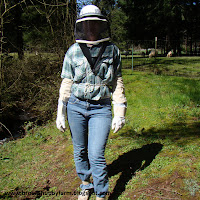
It was not easy for dad to work alone on the bees because he didn't want to hurt them and wearing gloves, coat, hat, etc. makes it hard. I'm going to have to buy dudds so I can get in and help out. Such fashionable clothing - maybe they come in a nice cornsilk blue or sage green.

April 12, 2010

To Bee Disappointed

Five days after installing the honey bees in their new home, we came to check on them. It was a warm (65 F), sunny, windless afternoon. My dad and I spent 30 minutes trying to get the smoker going. We'd get the newspaper lit and add some wood pellets. After pumping air through for a few minutes and getting some smoke going it would promptly go out. We made 4 or 5 attempts and then gave up. So we gathered up the gear - coat, hood, gloves, tools for extracting the frames, etc. - and headed down to the hive.

As we approached there were no bees coming or going - bad sign given the weather. They should be out and visiting flowers. Dad removed the lid and top feeder. In side all the bees were dead, including the queen. They hadn't moved much from when we closed up the hive last Tuesday. What did we do wrong?!

Going back over the steps - sugar water, queen with marshmallow plug, top feeder full, lid securely on - the only step we did wrong was to put the queen too far to the side instead of the middle of the hive. But that couldn't result in all the bees dying - could it?!

We dumped out the dead bees, packed up the equipment and headed to the house for some wine. What a huge disappointment.

Today my dad called the bees supply store where we had purchased the bees. They had sold 1200 cased of bees and only two reports (including ours) of all the bees dying. The clerk asked many, many questions about our process, set up, location, hive, food .... She concluded that the bees were very cold because of their trip across the pass and getting jostled into the hive in the cold and rain. This resulted in them not moving up in the hive to where the food water located (we have a top feeder). As a result they stayed where they were and starved to death. Sounds horrible!

We ordered another batch of bees, but we are now last in line and we won't get them until late May. At least the weather will be better then. If anyone has suggestions about getting the honey bees established, I'd love to hear.

April 6, 2010

The Bees are Here

Today we became caretakers of honey bees. The bees came in a cage, roughly the size of a large shoebox, and arrived at a supply store in Gresham. They were due to arrive yesterday however, a snow storm on the pass delayed the shippment by a few hours. So my dad headed down to the store today while I was at work. Apparently hundreds of people are adding honey bees this year. Dad said there was a steady line, dozens deep, to pick up cages and nucs of bees.

I met dad our here at our place. What a crappy day to bring the bees home - rainy, windy, cold - so we had to move fast. Step one, add some more nails to the frames (we learn in the class that the frames get really heavy and sticky and can come apart). The cage of bees was left in the car during this step. Next we had to get the queen's cage, as smaller cage with just queen inside, out of the larger cage. But first we had to whack the cage to make the bees drop to the bottom. Guess what, whacking the cage makes the bees a little unhappy. The larger cage had a tin can of sugar water in, which we removed to get inside and pull out the queen's cage and some of the angry bees escaped. Dad was stung on his finger but me and Jordan were unharmed.

With the queen out, and there were about 10-15 'attendant' bees on the outside of her cage, we had to remove the cork in her cage and replace with a marshmallow. (The other bees will eat through the marshmallow in a few days and during that time accept the queen vs killing her.) Dad pulled the cork and I shoved the marshmallow in, too hard and it went all the way in. Fortunately this was anticipated and we had a second marshmallow. This time I just plugged the opening. With some contorting into the hive, dad was able to tack the queens cage in the middle of the frames (see picture).

Next came the fun part - shaking the bees out of the cage and into the hive (see pictures). To entice the bees and maybe keep them from getting so pissed off, we spray sugar-water inside the hive. That worked great. Instead of swarming around, the bees landed in the hive and smelled the food - yum, yum - went right to eatting. Dad was stung again but it was because the bee got caught between his wrist and watch. After much whacking and shaking of the cage, we finally got most of the bees into the hive and put the frames back in careful not the squish the bees.

Interesting fact - bees don't pee and poop in their home. So during this disruption they took the opportunity to releave themselve. Dad got lots of poops on him. There was even bee poop on my camera.

April 4, 2010

Bees 101

Saturday my dad and I took a Bee 101 class through Urban Bounty, which sponsors a series of garden related classes in Portland. But before I get to all the cool stuff we learned .... Saturday night we went out with some friends and all of them asked what I was up to that day. To which I answered, "I took a class on raising bees." The responses I got were "Wow, you're brave." "Why would you raise bees?" "Aren't you worried about getting stung." Interesting, I was expecting responses like "Cool. Where are you going to keep them?"

Ok, back to the class. The first half was in a classroom with a powerpoint and demonstrations. The man, Glen, who taught the class, was obviously an expert. Every question asked was provided a very detailed answer. For example, someone asked about the worker bees and if they just spend all their time going out to get nectar and pollen. Glen said that there are actually a number of roles to play in the hive. The worker bees, all of which are female, each play one role. For example, one worker bee’s role may be to fly out and gather the nectar and pollen. She has two stomachs and stores a bit of the nectar in her second stomach, where some really scientific enzyme thing happens. When she returns to the hive she gives the nectar from her second stomach to a different worker bee, which puts the nectar in her own second stomach. Another scientific enzyme thing happens. She takes the nectar, which is now on its way to becoming honey, up inside the hive and deposits in the comb.

After lunch we went to Glen's houses in northeast Portland. It’s an older neighborhood and the houses all have small yards. Glen had 11 hives in his yard - 11. We got into a few of them. Normally, you would get into a hive on a nice warm day because most of the bees are out in the field and those in the hive are warm and happy and going about their work. However, Saturday was a cold, rainy, windy, nasty day. Very few bees were flying. Most were huddled together in the hive trying to keep warm. So when we came along and opened the hives, we really pissed them off.

Glen, of course, was in full beekeeper regalia (hood, jump suit, gloves) but the rest of us, about 30 people, were just in clothes and jackets. The angry bees buzzed around to check us all out. At one point I had about 20 bees on me. It did make me nervous - I was worried I would turn my head wrong or move my arm and squish a bee, which would sting me. So I just moved slowly. Out of the 30 people standing around in the cloud of angry bees for about an-hour-and-a-half, only one person got stung. (Interesting fact - male honeybees, called drones, don't have stingers at all.) Pretty amazing - thousands of angry bees, 30 people standing around and only one sting.

Our bees arrive Monday – I’m very excited!!!